The Smart Tipper's Guide: How Much to Tip, When to Tip, and How to Budget for It
You've just finished a great meal, the check arrives, and suddenly you're doing mental gymnastics. How much do you tip? Does the percentage change if you're at a counter-service spot versus a sit-down restaurant? What about tipping on delivery apps, hotel housekeeping, or when you're traveling abroad? Tipping culture has gotten more complicated — and more expensive — in recent years, and most people are just guessing.
This guide cuts through the confusion. You'll learn exactly when to tip, how much, and how to calculate it quickly — so you can be generous where it counts without feeling pressured into overtipping everywhere else.
Why Tipping Has Gotten So Complicated
A decade ago, tipping was mostly a restaurant thing. Today, tip prompts pop up at coffee shops, bakeries, self-checkout kiosks, and even online stores. A 2024 Pew Research survey found that 72% of Americans feel tipping is expected in more places than it used to be — and many feel social pressure to tip even when they're unsure it's warranted.
Part of the confusion stems from how tip prompts are designed. Many point-of-sale systems default to showing 20%, 25%, and 30% as the three options — nudging you toward higher amounts. Knowing the actual norms helps you make a deliberate choice rather than just tapping the middle button to avoid awkwardness.
The Standard Tipping Guide by Situation
Here's a practical breakdown of current tipping norms across the most common scenarios:
Sit-down restaurants: 18–20% for standard service, 22–25% for exceptional service. Tip on the pre-tax total if you want to be precise, though most people tip on the full bill.
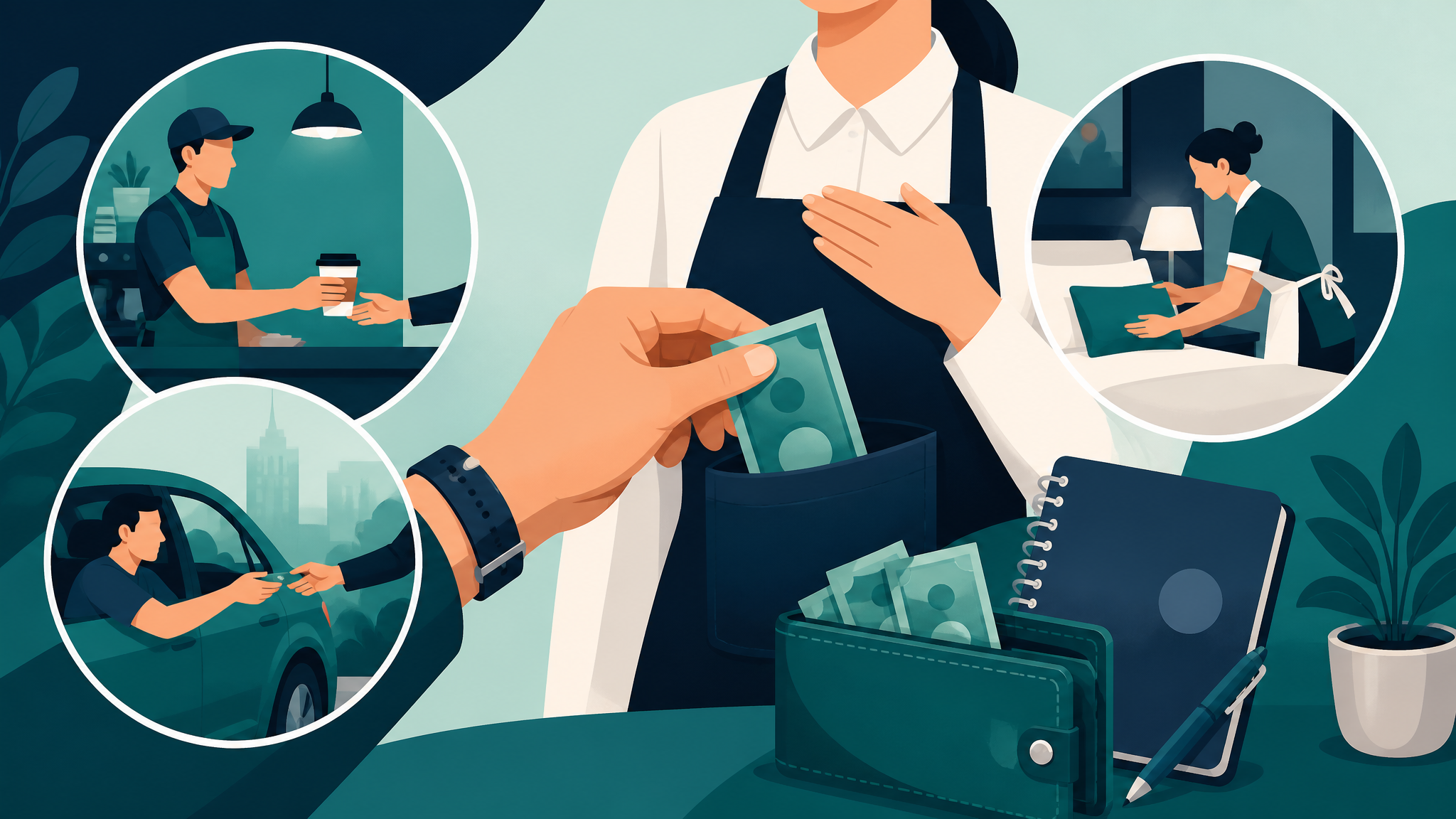
Counter service / fast casual: Optional. If there's a tip jar or prompt, $1–$2 for a simple order is appreciated but not expected. No tip is perfectly acceptable.
Coffee shops: $0.50–$1 per drink if you're a regular or the order is complex. Not expected for a simple drip coffee.
Food delivery (app-based): 15–20% of the order total, with a $3–$5 minimum. Drivers often rely on tips as a significant part of their income. Tip at checkout — not after delivery — since some platforms show drivers the tip amount before they accept the order.
Bartenders: $1–$2 per drink for simple orders, 15–20% for tab service or complex cocktails.
Hotel housekeeping: $2–$5 per night, left daily (not just at checkout, since different staff may clean your room each day). Leave it on the pillow or nightstand with a note that says "housekeeping."
Rideshare (Uber/Lyft): 15–20% for a standard ride, more for help with luggage or exceptional service. Always tip in-app rather than cash so the driver gets credit.
Hair salons and spas: 15–20% of the service cost. If the owner performs your service, tipping is still appropriate — the "don't tip the owner" rule is largely outdated.
How to Calculate a Tip Quickly (Without the Mental Math)
The fastest mental math trick: move the decimal point one place to the left to get 10%, then double it for 20%. On a $47 bill, 10% is $4.70, so 20% is $9.40. Add half of 10% ($2.35) to get 15% ($7.05). Simple.
But when you're splitting a bill with a group, calculating everyone's share plus tip gets messy fast. Our Tip Calculator handles the full calculation — enter the bill total, choose your tip percentage, and split it evenly across however many people are at the table. No arguments, no awkward rounding.
Tipping When You're Traveling Abroad
Tipping norms vary dramatically by country — and getting it wrong can be embarrassing in both directions. In Japan, tipping is considered rude and can even cause offense. In Australia and New Zealand, it's uncommon and entirely optional. In much of Europe, rounding up the bill or leaving small change is the norm, not a percentage-based tip. In the United States, Canada, and Mexico, tipping is deeply embedded in service culture and often expected.
Before you travel, look up the tipping customs for your destination. When you do tip abroad, you'll also need to think about currency. If you're calculating a 15% tip on a bill in euros, pounds, or pesos, it helps to know the rough exchange rate. Use our Currency Converter to quickly check what your tip amounts to in your home currency — especially useful when you're trying to stay within a daily travel budget.
When It's Okay Not to Tip (And When It's Really Not)
There's a difference between situations where tipping is optional and situations where skipping it genuinely harms a worker. In the U.S., tipped workers in many states are legally paid a lower base wage (as low as $2.13/hour federally) with the expectation that tips make up the difference. For these workers — restaurant servers, bartenders, delivery drivers — not tipping isn't a protest against the system; it directly reduces their take-home pay.
On the other hand, tipping is genuinely optional at:
Self-service kiosks and automated checkout stations
Online purchases and digital downloads
Counter-service spots where you order, pick up your own food, and bus your own table
Businesses where the owner is the sole employee and pays themselves a full wage
If you're unsure, a quick rule of thumb: if someone is providing a personal service that requires skill, time, or physical effort on your behalf, a tip is appropriate. If you're essentially serving yourself with a digital interface, it's optional.
Budgeting for Tips So They Don't Catch You Off Guard
One reason people feel stressed about tipping is that they don't budget for it. If you're going out to dinner and the bill is $80, your actual cost is closer to $96–$100 once you add a 20% tip. If you're booking a hotel for five nights, add $10–$25 to your budget for housekeeping. If you're ordering delivery three times a week, that's an extra $9–$15 per week in tips alone.
When you're planning a night out or a trip, use our Discount Calculator to work backward from your total budget. Enter your target spend, subtract the estimated tip percentage, and you'll know exactly how much you can spend on the meal or service itself without going over.
A Note on Tip Pooling and Automatic Gratuities
Many restaurants automatically add an 18–20% gratuity for large parties (typically 6 or more). Always check your bill before adding an additional tip — it's easy to double-tip without realizing it. The line item is usually labeled "auto gratuity," "service charge," or "suggested gratuity."
Some restaurants have also moved to a tip-pooling model, where tips are shared among the entire staff — including kitchen workers who traditionally weren't tipped. This is worth knowing because it means your tip may benefit more people than just your server, which many diners consider a positive change.
The Bottom Line
Tipping doesn't have to be stressful or confusing. Know the norms for each situation, budget for tips as part of your total cost, and use the right tools to do the math quickly. When you tip with intention — rather than just tapping whatever the screen suggests — you'll feel better about the money you spend and more confident in every transaction.
The goal isn't to tip less. It's to tip smart: generously where it matters, deliberately everywhere else.
Before you act on this
This article is for general educational purposes only. Everyone’s situation is different, so before making any decisions please refer to a relevant qualified professional who can advise you based on your specific circumstances.