How to Estimate Paint for Any Room (And Stop Wasting Money on Extra Cans)
You've picked the perfect color. You've taped the trim. You've laid down the drop cloth. And then you open the last can of paint — and it's not enough. Sound familiar? Miscalculating paint is one of the most common (and frustrating) DIY mistakes homeowners make. Either you buy too much and end up with half-used cans collecting dust in the garage, or you run short and have to make an emergency hardware store run mid-project, hoping the new batch matches the old one.
The good news: estimating paint is actually pretty simple once you know the formula. In this guide, we'll walk through exactly how to calculate paint coverage for any room — walls, ceilings, trim, and all — so you can buy the right amount the first time.
The Basic Formula: Square Footage ÷ Coverage Rate
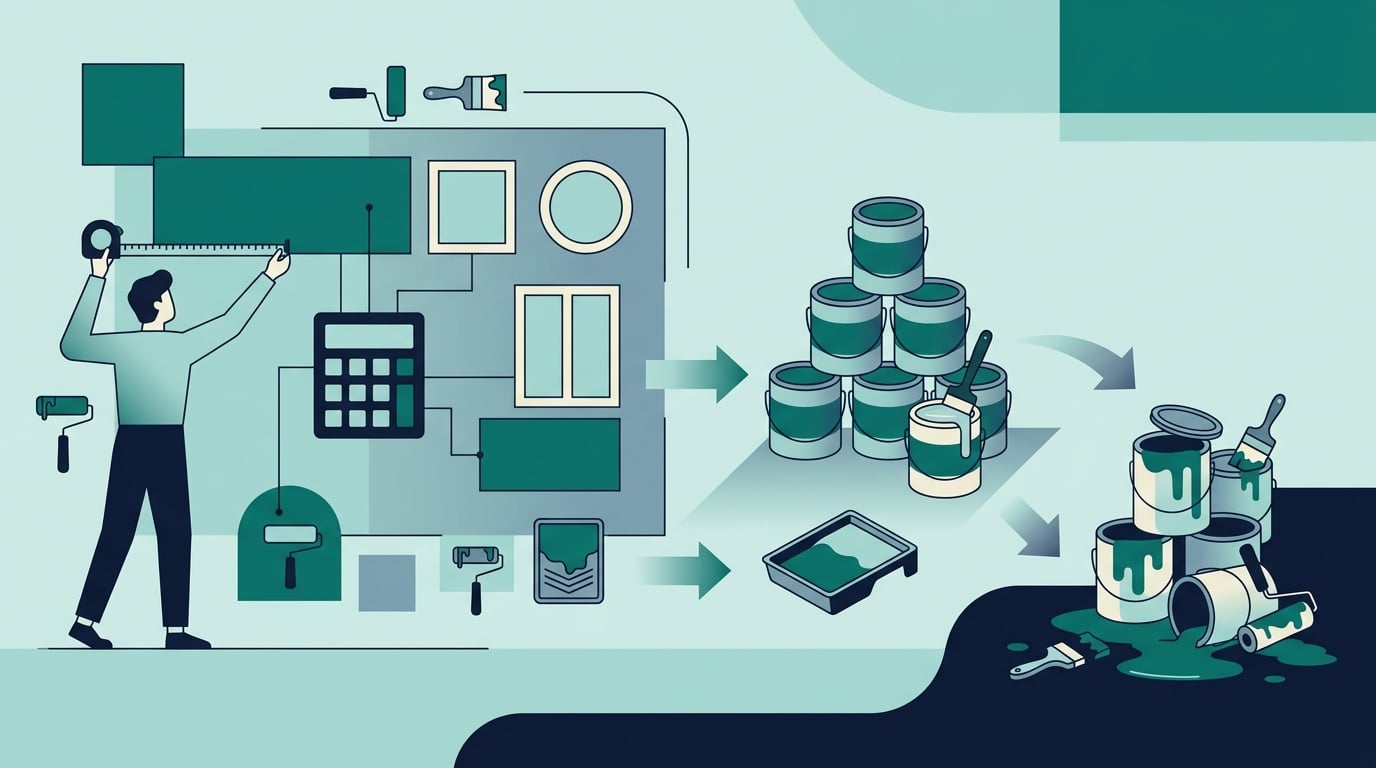
Every can of paint lists a coverage rate — typically 350 to 400 square feet per gallon for a single coat on a smooth, primed surface. Your job is to figure out the total paintable square footage of your room, then divide by that coverage rate.
Here's the basic formula:
Measure the width of each wall and multiply by the ceiling height to get the square footage of that wall.
Add up all four walls (or however many you're painting).
Subtract the area of doors (roughly 20 sq ft each) and windows (roughly 15 sq ft each).
Divide the total by the paint's coverage rate (use 350 sq ft/gallon to be safe).
Multiply by the number of coats you plan to apply.
For example: a 12×14 ft room with 9-foot ceilings has a perimeter of 52 linear feet. Multiply 52 × 9 = 468 sq ft of wall space. Subtract one door (20 sq ft) and two windows (30 sq ft total) = 418 sq ft. Divide by 350 = 1.19 gallons per coat. For two coats, you need about 2.4 gallons — so you'd buy three quarts and one gallon, or just two gallons to be safe.
Working in Metric? No Problem
If your tape measure is in centimeters or meters — or if you're buying paint from a brand that lists coverage in square meters per liter — you'll need to convert. This is where a lot of DIYers get tripped up. A quick way to handle this: use the Metric-Imperial Converter to flip between feet and meters instantly, so your measurements always match the units on the paint can.
For reference: 1 gallon ≈ 3.785 liters, and 1 square foot ≈ 0.093 square meters. So if a paint covers 10 m² per liter, that's roughly 107 sq ft per liter, or about 405 sq ft per gallon — right in the standard range.
Don't Forget the Ceiling
Many first-time painters forget to account for the ceiling — or assume it's included in their wall estimate. It's not. Ceiling paint is usually a separate product (flat finish, often white), and you'll need to calculate it separately.
For a ceiling, just multiply the room's length by its width. Our 12×14 ft room has a 168 sq ft ceiling. At 350 sq ft/gallon, that's less than half a gallon per coat — so one quart is usually enough for a single coat, or one gallon for two coats.
Trim, Doors, and Baseboards: The Forgotten Surfaces
Trim paint is typically sold in quarts, and a single quart covers about 100 linear feet of baseboard or trim at standard widths. Measure the total linear footage of your baseboards, door frames, and window casings, then divide by 100 to estimate quarts needed.
Doors are usually painted separately with a semi-gloss or gloss finish. A standard interior door (about 20 sq ft per side) takes less than a quart for two coats — so one quart of trim paint typically covers both sides of a door plus all the trim in a standard room.
Adjusting for Surface Conditions
The 350 sq ft/gallon estimate assumes a smooth, previously painted, primed surface. Real-world conditions often require adjustments:
Unpainted drywall or bare wood: Reduce coverage by 25–30%. These surfaces are porous and absorb more paint. A primer coat is strongly recommended before your finish coats.
Textured walls (orange peel, knockdown): Reduce coverage by 15–20%. The texture increases the actual surface area.
Dark colors over light (or vice versa): Plan for an extra coat. Going from white to deep navy? You might need three coats for full coverage.
High-quality paint: Premium paints often have better coverage — some claim 400+ sq ft/gallon. Check the label and use the manufacturer's stated rate.
To quickly calculate how much extra paint you need for a porous surface, use the Percentage Calculator to find 25% of your base estimate and add it to your total. It takes 10 seconds and saves you a second trip to the store.
How to Buy Smart: Gallons vs. Quarts
Paint is sold in quarts (0.25 gallon), gallons, and sometimes 5-gallon buckets. Here's a quick buying guide:
If you need less than 1 gallon, buy quarts — they're more economical for small jobs.
If you need 1–4 gallons, buy individual gallons.
If you need 5+ gallons (large rooms, multiple rooms, or exterior), a 5-gallon bucket is almost always cheaper per gallon.
Always buy a little extra — about 10% more than your estimate — for touch-ups later. Store it in a cool, dry place with the lid sealed tight.
Putting It All Together: A Real-World Example
Let's say you're painting a 10×12 ft bedroom with 8-foot ceilings, one door, and one window. You want two coats of wall color and one coat of ceiling paint.
Wall perimeter: (10+12) × 2 = 44 linear feet × 8 ft = 352 sq ft
Subtract door (20 sq ft) + window (15 sq ft) = 317 sq ft of paintable wall
Two coats: 317 × 2 = 634 sq ft ÷ 350 = 1.81 gallons → buy 2 gallons of wall color
Ceiling: 10 × 12 = 120 sq ft ÷ 350 = 0.34 gallons → buy 1 quart of ceiling paint
Trim: estimate 40 linear feet of baseboard + door frame → buy 1 quart of trim paint
Total spend: 2 gallons wall color + 2 quarts (ceiling + trim). Clean, simple, no waste. If you're working with metric measurements or need to convert your room dimensions, the Unit Converter makes it easy to switch between feet, meters, and inches without doing the math in your head.
Final Tips Before You Start Rolling
Always buy paint from the same batch (same lot number) to ensure color consistency across cans.
"Box" your paint — pour all cans into a large bucket and mix together before starting. This eliminates subtle color variations between cans.
Keep a small amount of leftover paint for touch-ups. Label the can with the room name, color name, and date.
If you're unsure about a color, buy a sample quart first and paint a large swatch on the wall. Live with it for 24 hours before committing to gallons.
Painting a room is one of the highest-ROI home improvement projects you can do — a fresh coat of paint can transform a space for a few hundred dollars. Getting your paint estimate right means you spend that money on color, not on waste. Measure twice, calculate once, and enjoy the results.
Before you act on this
This article is for general educational purposes only. Everyone’s situation is different, so before making any decisions please refer to a licensed contractor and check your local building codes and permit requirements who can advise you based on your specific circumstances.